
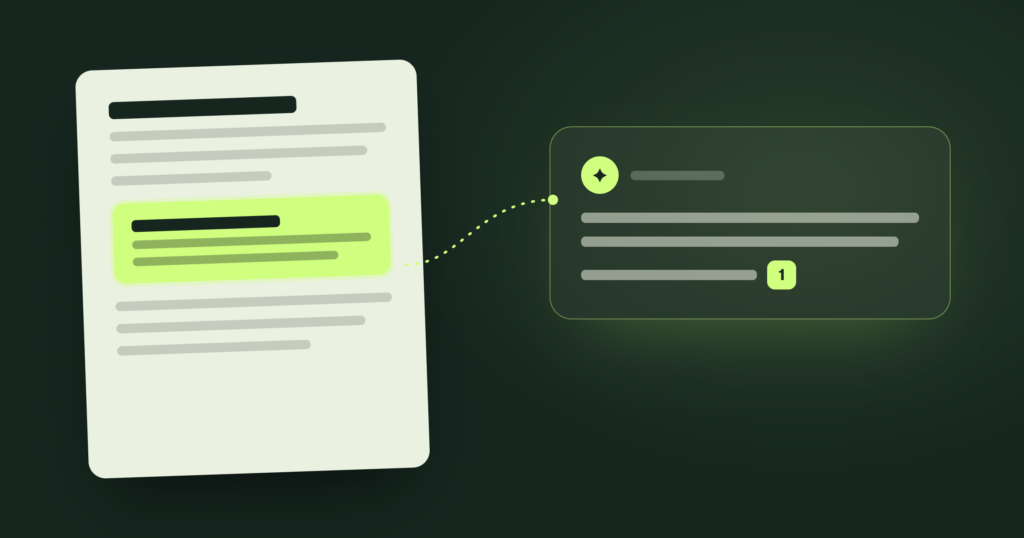
There’s a particular kind of frustration in publishing genuinely helpful content and watching AI assistants recommend someone else. Usually it isn’t that your information is worse. It’s that theirs is easier for a model to lift, trust and repeat.
Getting cited by ChatGPT, Gemini and Perplexity is as much about structure as substance. Here’s a practical formula for writing pages that AI can actually use, without turning your site into robotic, soulless copy.
Lead with the answer
The single biggest change you can make: put the answer first. AI systems reward content that resolves the question in the opening lines, then adds detail underneath. Most business writing does the opposite, warming up for three paragraphs before saying anything useful.
If the page is “how much does a new kitchen cost?”, the first sentence should give a real range. Context, caveats and the sales pitch can follow. A model scanning for a quotable answer will find it immediately, and you.
Write question-led headings
Phrase your headings as the questions people actually ask, then answer each one directly beneath. This does two things: it matches the natural-language way people query assistants, and it turns your page into a series of clean question-and-answer pairs, which is the single most extractable format there is.
- Instead of “Our Process”, try “What happens during a kitchen fitting?”
- Instead of “Pricing”, try “How much does a fitted kitchen cost in 2026?”
- Instead of “Why Choose Us”, try “How do I choose a kitchen fitter?”
Be specific, and use numbers
Vague pages are hard to cite. “Competitive pricing” and “fast turnaround” give a model nothing to quote. Concrete facts, ranges, timescales and figures give it everything.
Cost questions are among the highest-volume queries people ask AI, and the businesses that answer them plainly, with real numbers, get recommended far more often than the ones hiding behind “contact us for a quote”. Specificity reads as confidence, and models pass that confidence on.
AI tools cite pages with concrete numbers over vague “get in touch” pages, every time.
Add a genuine FAQ
A short FAQ at the foot of a page is one of the highest-leverage things you can add. Question plus immediate answer is the most quotable content format for an AI assistant, and it’s how your customers phrase things anyway. Write each question exactly as a person would say it out loud, and keep the answer to a tight paragraph.
Back it with FAQ schema and you’ve handed the model a clean, machine-readable Q&A on a plate.
Make who, what and where obvious
An assistant won’t recommend a business it can’t pin down. Somewhere prominent, state plainly what you do, who you do it for and where you operate. “We’re a family-run kitchen fitting company serving Essex and east London since 2009” tells a model exactly when to name you. “Transforming spaces, exceeding expectations” tells it nothing.
Format for extraction
Dense paragraphs hide your best facts. Help the model (and the reader) by breaking content up:
- Short paragraphs, one idea each.
- Lists for anything you’d naturally say as “we offer A, B and C”.
- Tables for comparisons, tiers or specs.
- Clear headings so each section stands on its own.
Keep it current
Show a publish or updated date, and actually maintain your cornerstone pages. A cost guide dated this year is a stronger, safer thing for an assistant to cite than an undated page that might be from 2021. Freshness is a trust signal, and trust is what gets you named.
A quick before-and-after
Before: a “Services” page with a hero image, a paragraph of brand language, and a “Get in touch” button.
After: the same page, reworked so the top line answers “what does this business do and for whom?”, with question-led headings, a couple of real price ranges, a five-question FAQ, and an updated date in the footer. Same business, same services, wildly different odds of being recommended.
The checklist
- Answer the core question in the first two lines.
- Turn headings into the questions people ask.
- Replace vague claims with specific numbers.
- Add a real FAQ, backed by schema.
- State who, what and where plainly.
- Break prose into lists, tables and short paragraphs.
- Show and maintain dates.
Do this on your highest-value pages first, the ones tied to the questions your customers actually ask, and you’ll be writing content AI can’t help but cite. If you’d like to know which of your pages are closest already, a Grow Hero scan will point you straight at them.